The famous grave of Ozu Yasujiro has only the single calligraphic character 無 or nothing
Although in the common sense “nothing” is used to refer to the absence of objects determined in a specific place and time. It should not be confused with non-existence. The void is the double negation: it contains nothing.
Ozu lived with his mother all his life. he saw life changing for the worse, the Japanese losing traditional values.

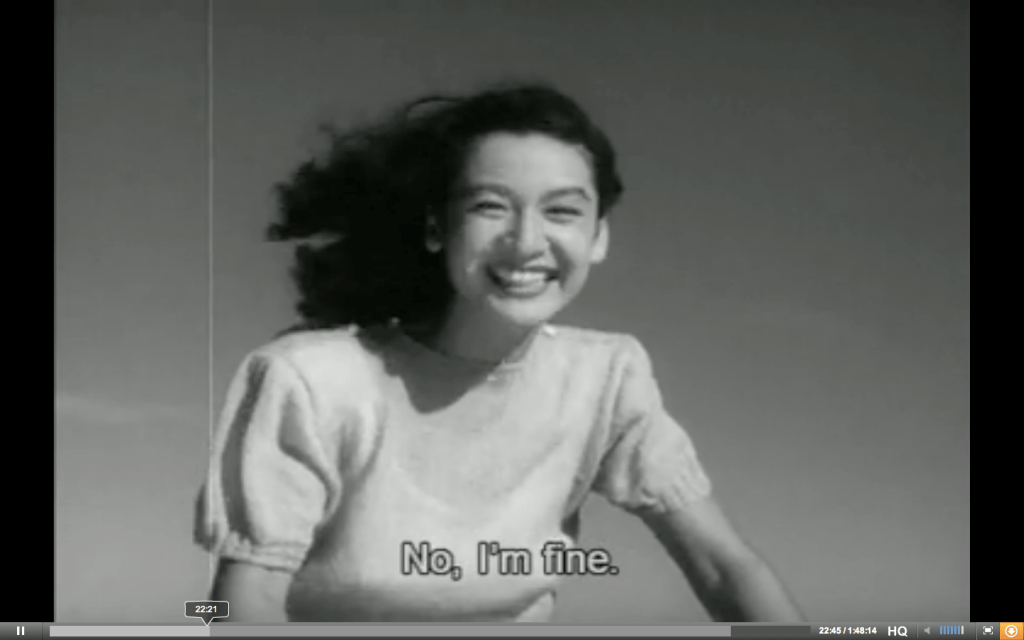
Although not a fan of modern times, but he’s neither a fan of all traditional values, for example, in Early Summer (1951), he is dismissing patriarchal beliefs and letting a female character marry the one she loves, against the wishes of her family.
Ozu: “I tried to represent the collapse of the Japanese family system through showing children growing up.”
This “nothingness” was at the heart of his life and his films. For westerners, it may appear to be nihilistic, but for Ozu it was an achieved state of grace.
“Naturally, a film must have some kind of structure or else it is not a film, but I feel that a picture isn’t good if it has too much drama or too much action.”
— Yasujiro Ozu
But mu’s more profound meaning goes way beyond nothingness. It’s more like the concept of emptiness in buddhism, which is not actually empty at all. More like the infinite potential in everything.
- One can remain in the hyper-productive world of postmodern culture. One could try to engage with it on critical terms, trying to remain distanced-while-still-engaged. However, for the reasons spelled out above, this seems an untenable option. The very unfulfillment and nihilism prevalent in postmodern culture excludes not-partaking, and as such constitutes a form of violence towards one’s integrity.
- One could withdraw from the world of postmodern hyperproduction. However, to withdraw seems no solution, as the reach of culture and technology, and especially digital culture and technology, is so effective that any withdrawal, apart from becoming a hermit, seems impossible or at least ineffective. Moreover, it is quietist because it amounts to a degree of defeatism. It deals with the world by withdrawing in a gesture of silent resignation. The subjective space in which one manoeuvres oneself by quietist withdrawal is derivative in the worst sense: it defines itself as everything that the postmodern world is not. But as such, it is crucially dependent for its continued existence on the very world it rejects, thereby allowing the pervasive nihilism that underlies it in via the backdoor.
Irrevelance
The emergence of the new subjective body is the ultimate political nightmare of the powers-that-be and the high priests of the status quo. By an exact analogy, the new subjective body is to those powers-that-be and those high priests, what creative piety is to the logic of objectification and advanced capitalist hyperproduction. The new subjective body represents a world order that does not require the continued and uninterrupted existence of the old order, but instead projects a new existential possibility. Moreover, it is a viable possibility that has the potential to replace the existing by mercilessly demonstrating its essential irrelevance.


Pointlessness
Tillich starts with the concept of courage, a virtue that is sorely needed in the face of impending meaninglessness. But although Sartre and Tillich conceptualize the problem of the human condition very differently, they both propose the same solution: to go forth and create meaning. But then, in a world in which the assumed truth of natural and advanced capitalist production reign supreme, being tasked with creating meaning is not the antidote to nihilism, but instead its cause. One is tasked with performing an impossible task, anxiously pacing back and forth between meaninglessness and the demand to create meaning.
The self
Or we think about “the self from within the confines of the self” (Nishitani, 1983: p. 95).
Through the window intense vitality


The aesthetic or artistic attitude relies on a sensitivity and openness that expands well beyond the confines of the theoretical or scientific mind.
For us to access phenomena or entities in their suchness, we require a non-objectifying gaze. To illustrate what that gaze is like, Nishitani approvingly quotes an example from Dostoevsky:
As Dostoevsky himself tells us, [the Kirghiz steppes] is the only spot at which he saw “God’s world, a pure and bright horizon, the free desert steppes”; in casting his gaze across the immense desert space, he found he was able to forget his “wretched self.” (Nishitani, 1983: p. 8)
But for such commonplace things to become the focus of so intense a concentration, to capture one’s attention to that almost abnormal degree, is by no means an everyday occurrence.… [T]hings that we are accustomed to speak of as real forced their reality upon him in a completely different dimension. (Nishitani, 1983: p. 8)
The non objectifying gaze
Noetic light
Grace
Palamas conceives of noetic illumination as “the place of God,” as an entrance into the sphere where the divine resides. But, as we have seen, this place is not some transcendent place or afterlife, but instead the very same manifestly real world that we inhabit and that we have to learn to appreciate anew. Our sense of creative piety encounters its own purity through an act that we can only describe as “grace,” since we lack the concepts to express it adequately and fully.
The philosophy of The Kyoto School touches on the core teaching of apophatic theology, according to which the divine as such is unknowable. Yet, in order to experience the divine, attentiveness or concentration (called either prosōche or samāhdi) is required in order to activate what Palamas calls the “noetic light.” We have the “natural light” (for the Empiricists) of our senses and (for the Rationalists) of our reason, but Palamas holds that there is a level of human experience that radically surpasses these capacities
Once we succeed in enacting a non-objectifying gaze, the experience strikes us as not only bewildering or even terrifying, but also as intensely alive and vital. When the world around us manifests itself as “more real than real,” then we see all things around us in their “suchness.” They simply are, in such a way, and with such a force and vivacity, that transcends the objectifying mundanity of everyday life. Every object is seen in a new light, thereby uncovering an entirely different qualitative level of perception and experience. Dostoevsky describes how in such experiences, even the smallest things reflect eternity: the cry of a baby, the rising sun on a leaf, the colours of a butterfly’s wing…. All these things communicate “a mystical order that rules over all things, so that God can be seen in any of them” (Nishitani, 1983: p. 9).The topos of God is everywhere, spatial infinity and temporal eternity both immanently reflected in a drop of water.
NO PLACE
[G]od is not a Spirit, according to the words of St. Gregory (…) Therefore he says “He came to a place”. The place is God, Who gives position and order to all things. I have said before that all creatures are full of the least of God, and grow and flourish therein, and His greatness is nowhere. (Walshe, 2018: p. 222, sermon 39)
“God” is a place from which to act, an anchor to connect with and derive strength from. This anchor is not a dogma or set of firm convictions, but the very principle “[that] gives position and order to all things.
This is why we read in the Bible the curious statement that we must become “like strangers on the Earth.” Quite literally, this amounts to be “born again” with such an intensity that one regards the world with new eyes. And what happens is that the world appears to those new eyes as utterly disjointed and strange. Above all, this disjointedness and strangeness appear as a composite phenomenon or mode of being that cannot be reconstructed into a coherent cognitive picture. But it is in this suchness (shinnyo/tathagata) that we are able to find the means to negate the seemingly all-encompassing advanced capitalist mode of production, as we will see.
Members of both Jesuit and Franciscan orders were required to spend time as beggars, travellers, and pilgrims in order to experience humanity and the world from an “outsider” perspective. In doing so, they adopted an attitudinal disposition of creative and moral piety that was religiously expressed.
Is shaping a new subjective space really possible, and if so, how? I claim that it is really possible, but defeatism, resignation, or withdrawal in the quietist sense will not suffice. Instead, we must turn towards tradition and towards appropriating tradition in a way that is relevant for our times.
So, we can either probe reality by means of sensibility or by means of understanding/theoretical reason, but the thing-in-itself or noumenon is forever out of reach.
 Sarah Miles Films