HE THREW COLD WATER ON THIS ELATION
TEXT Gaëlle GINESTET
…. there is a morbid attraction for destructive water that seems to pervade film after film in the same period as Une femme douce, and seems to affect several of Bresson’s characters, but not our “gentle Ophelia”. This can simply be explained by the fact that Bresson followed Dostoevsky’s narrative in which the young wife jumps out of the window
If one were to play Mouchette and Une femme douce one after the other, the two suicides would only be separated by the opening credits of Une femme douce.
Dislocated singing as a symptom of psychosis: common language breakdown. (also seen in The Embryo Hunts in Secret Koji Wakamatsu 1966 quoted in Something and Nothing 2021)

SCREENGRAB SOMETHING AND NOTHING 2021
Is this really an allusion to Hamlet? Nothing is less certain, since her humming is already present in Dostoevsky’s novella.
Yet the marriage seems to have started off rather happily: in the wedding night scene, she laughs and jumps on the bed, but in the voice-off commentary, her austere new husband states that he “threw cold water on this elation” (“j’ai jeté de l’eau froide sur cet enivrement”).
Even if the excerpt from Hamlet is restricted to five minutes towards the middle of Une femme douce, the play, I would suggest, irradiates the film, since it is impossible not to notice some similarities between both works, especially between the characters of Ophelia and the “gentle woman”2.
In the film, the Hamlet performance has the status of “retro-prospec- tive” embedded narrative, to adopt Lucien Dällenbach’s terminology, which means that it “reflects the story by revealing events both before and after its point of insertion in the narrative”
the paleness of a dead woman, the evanescence of a drowned body floating on water (she evokes Ophelia long before we attend a performance of Hamlet)”4. The whiteness of her skin (see Plate 1) recalls a dead body as much as it does an ivory statue or a nude in a painting which is quite significant of the way her husband sees her as an object of pleasure: “je ne cherchais que la possession de son corps”—“I only sought the possession of her body”.
Flowers are forever associated with Ophelia in the play as in collective imagination, mainly owing to the famous painting by John Everett Millais. The gentle woman holds a splendid bunch of daisies that she eventually discards and abandons on the side of the road.
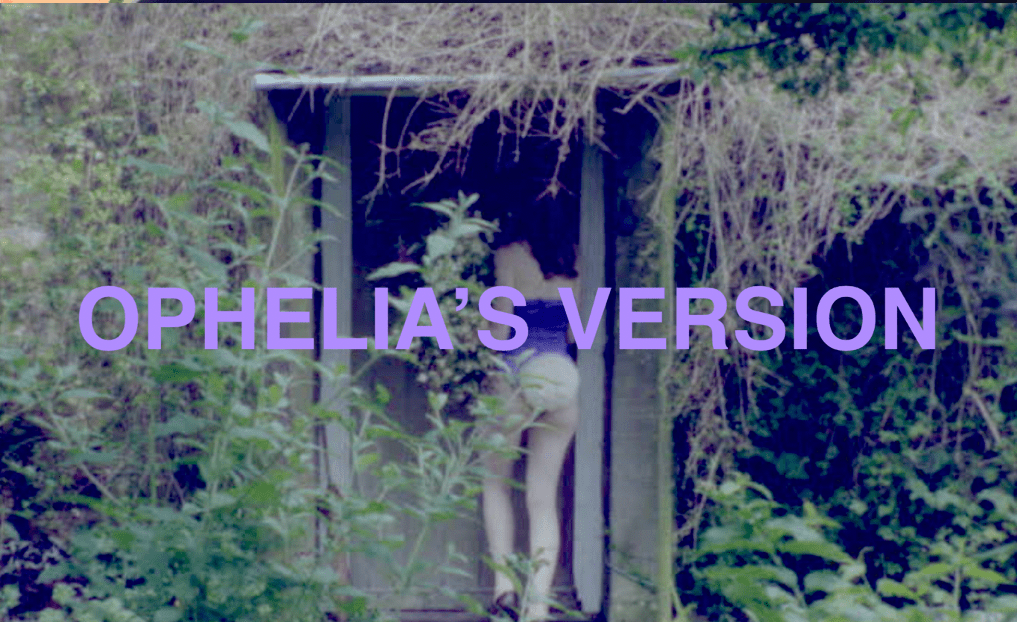


SCREENGRABS 2001 A FAMILY ODYSSEY OPHELIA’S VERSION
- Robert Bresson underlined the strangeness of Mouchette’s death in the river: “What shocked me in the book is that Bernanos made her die by wanting to put her head in the water as if on her pillow in bed. I’ve never seen anyone committing suicide like that—waiting for death in the water” (Bresson interviewed by Ronald Haymann, London, Transatlantic Review 46/7, 1973, retrieved on 14 November 2010 from <www. mastersofcinema.org/bresson/Words/TransAtlanticReview.html>). This is why, in his filmic adaptation, he gave Mouchette’s fall into the river the appearance of an accident.
- Bresson’s usual way of filming, which is an aesthetics of fragmen- tation, relying much on inserts and close-ups. It only presents two types of shots: full and medium.
- This might be another sign that the gentle woman is a bird in a cage: she wears a dressing gown adorned with birds, and she reads the book about birds aloud just before the scene where she leaps out of the balcony—in a way, she dies by trying to fly away…
- The ultimate link between Hamlet and the gentle woman is their es- sential questioning: what is being human, living, dying?
- the gentle woman is absorbed in her natural history book, only to realize that all beings are made up of “the same raw material” (“la même matière première”). Hamlet and Une femme douce illustrate Bresson’s thoughts, since a similar essential search, spelt out in the Notes on Cinematography with the same words as in Une femme douce, is at the core of his work as a filmmaker: “Not to shoot a film in order to illustrate a thesis, or to display men and women confined to their external aspect, but to discover the matter [matière] they are made of. To attain that ‘heart of the heart’ which does not let itself be caught either by poetry, or by philosophy or by drama”32.
- She discovers that, as Hamlet says, man is nothing more than “the paragon of animals” (2.2.297). If, as Jean Sémolué writes, “from start to finish, Une femme douce remains the film of doubt, of unanswered questions”33, the gentle woman seems to have found her answer to the question “To be or not to be?”.
CLIP SOMETHING AND NOTHING
 Sarah Miles Films