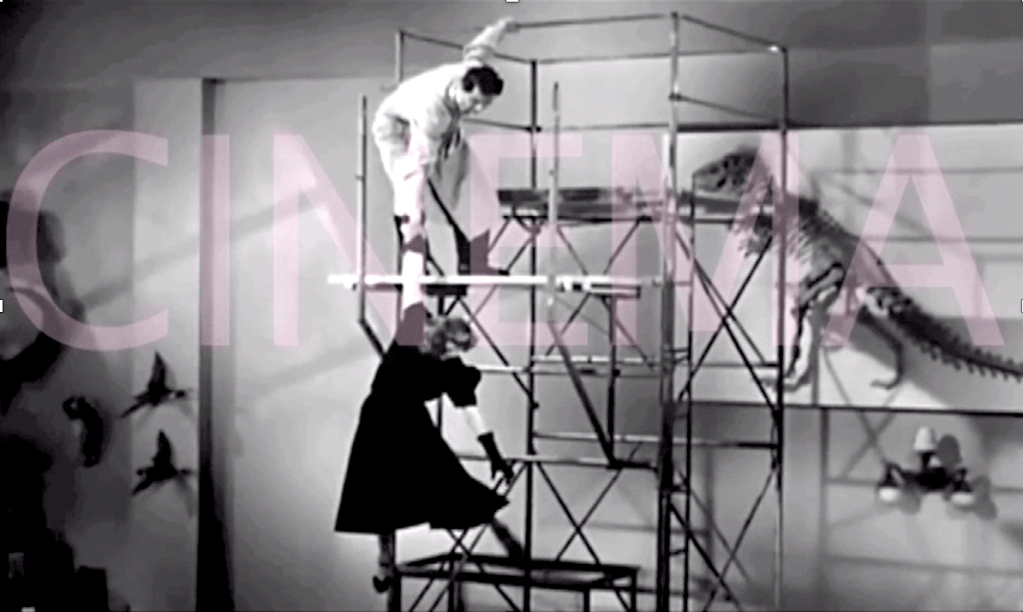
Closing sequence of Bringing Up Baby
CINEMAMA draws inspiration from the closing scene of Bringing Up Baby dir Howard Hawks and the collapse of the Brontosaurus skeleton. It’s repeated matching elements may be read as a metaphor for a strip of film whose collapse raises questions of the relation between work and love, science and art, past and present and a visual manifestation of the characters’ struggles with their own desires, social expectations, and the unpredictability of life.
Stanley Cavell Contested Tears
Stanley Cavell’s idea of philosophy as autobiography,
where writing about oneself with the I narrator does not necessarily mean finding one’s self.
Finding one’s voice is a matter of how this “I” rerelates itself to culture, conforming to constraints and yet (therefore) producing something new from within them.’ 1
The child inherits the voice from the parents and grandparents and the origins of this voice are an ineradicable inheritance and the absorption into their oppositional griefs is a source of isolation .
He writes that the act of finding entails the act of stealing, misgiving and burying as critical conditions for rediscovering. These aspects make an autobiographical exercise the work of mourning.
This is not about articulation and identity of the self but of encountering persevering and acknowledging the gap within the self.
To take an interest in an object is to take an interest in one’s own experience of the object so that to examine and defend my interest in these films is to defend my interest in my own experience
Soft Fiction
For Cavell the basis of the film medium is photographic. A photograph, and by extension film, always implies the presence of the rest of the world. Film “displaces” people and objects from the world onto the screen. This is not only proof, for Cavell, of film’s ontological realism, it is also the beginning of our reconciliation with the world. Movies permit us to view the world unseen, at a distance, and this sets in motion the intellectual process that will bring us back to the world and will reaffirm our participation in it. More than any other film critic or theorist, Cavell insists that film’s fundamental realism makes it an art of contemplation, an intellectual and spiritual exercise meant to restore our relation to the world. 1
In 1969 the year Jean Luc Godard’s Weekend was released my family moved to West Dorset, my young artist parents renegade from disapproving families. We found ourselves buried in the deep dark country, the grass reached my fringe and the stream was full of rainbow trout and the elsan lorry came by once a week. Before long my dad lost his job at the comprehensive but that was Ok he’d made friends with a local lord of the manor and they started a private press. My dad was taking pictures for Derek Jarman poems and then a brief affair with film. I appeared in one of these films called Clothes in a Museum wearing Elizabeth Taylor’s costume from National Velvet. A film in which a young girl masquerades as a boy to win a race.2
Survivors don’t make plans.
1 A pitch for philosophy Stanley Cavell
2 Throughout her childhood, horses so deeply excited Velvet Brown (Elizabeth Taylor) that merely to look at them was ecstasy. She lost her heart to one at twelve, when she first saw a neighbor’s fierce new gelding running majestically through a meadow. Without quite realizing it..

 Sarah Miles Films