
SCREENGRAB IT MIGHT EVEN BE KIND OF A RELIEF TO BE FINISHED MARILYN MONROE 2023 In Lolita there is an erotic scene on a quiet Sunday morning wherein the narrator intercepts an apple from Lolita
…………and then I knew that the hopelessly poignant thing was not Lolita’s absence from my side, but the absence of her voice from that concord.”
“‘Lolita’ should make all of us— parents, social workers, educators—apply ourselves with still greater vigilance and vision to the task of bringing up a better generation in a safer world.”
Lolita as a morality play, but even in the opening pages the edict was clear: the wages of sin were indeed death. The story, which I had recollected as a droll, satiric view of American life—a premise reinforced by my recall of the Kubrick movie—I now saw as tragic. Humbert and Lolita both died, Lolita’s baby was stillborn, Humbert’s childhood sweetheart had died of typhus, and his first wife had succumbed in childbirth. Lolita’s mother had an accident, her friend died of cancer, Lolita’s first love was killed in Korea, and Humbert’s rival was murdered by him. Reading the book with Sandra in mind, I realized that to Humbert, Lolita was an object to be conquered. Cruelty and power were the cudgels behind the silky sentences.
It wasn’t the sexual act that was ugly, but rather his corruption of love and nurturing into sexual performance
EXCERPT I SPEAK FOR THE CHILD TRUE STORIES OF A CHILD ADVOCATE
GAY COURTER
the book is not a love story, sexualising was the opposite of what Nabokov set out to do

Screengrab It might even be a kind. of relief to be finished Marilyn Monroe 2023
THE FIFTIES
To say that had Nabokov succeeded in his attempts to move to England instead of America in the late 30s, there would have been no Lolita – and not just because of the open road or the gum-chewing teen: the whole shape of the narrative, the language and energy of it, is unimaginable without the American landscape and culture
A professor called Humbert Humbert (repetition compulsion) humping of course
has an erotic frisson for Dolores Haze he marries her mother and when she dies he
becomes her carer he skips town and takes her on a year long road trip: he abducts her.
Struggling to complete his novel Nabokov read an article about Sally Horner her story bearing a marked similarity to Lolita.
This is the sad short life of Sally Horner and her twenty month long kidnapping.
She was born in Kanzas her Mother a widow and seamstress whose husband had killed himself five years prior, she had an older sister Susan.
Sally wanted to join the cool girl’s club at school and the intitiation to popularity was to go into Woolworths and steal a 5 cent notebook, shehad never stolen anything before but on
June 13th 1948 she did and as she rushed toward the exit she felt a hand on her arm, a man
wearing a fedora his face scarred with a half moon brand told her
he was an fbi agent and she was under arrest, he duped her into believing if she reported to him he would let her go, so she ran home and some days later
he ambushed her, telling her she had to go with him to Atlantic City
he instructed her to tell her mother she was going with a friend
and he followed up with a phone call posing as the friend’s father.
He was Frank La Salle he had been released from prison for the rape of five children.

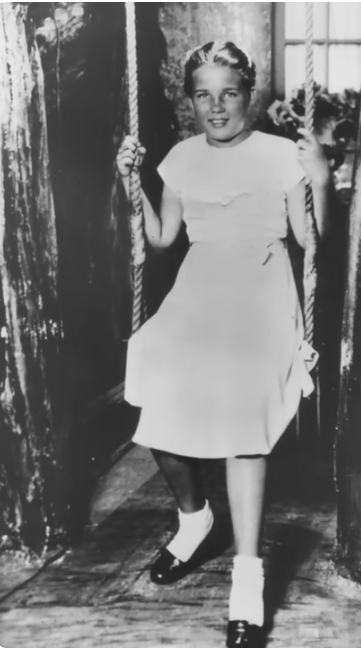
For a time Sally attended school in Dallas Texas and they moved around living in a trailer parks..
By sept 1950 Sally went into hospital with appendicits? and her mood changed, abortion? she seemed haunted, she began rejecting La Salle’s advances.
A neighbour in the trailer park Ruth Genesh noticed her and suspected something.
so when she left the park she suggested Frank follow them to California San Jose,
finally while Sally was alone Ruth invited her over to her trailer and Sally told her she wanted to go home.
She was returned to Philadelphia by plane where she was sent to a juvenile centre for examination.
Frank LaSalle was arrested for sex kidnap in1952 and convicted.
On august 16th 1952 after enduring being bullied at school Sally had made.friends with a girl called Carol and they travelled out to Wildwood. Whilst there and on a date with a young man called Ed. Just after midnight sally and ed drove his 1948 ford sedan into a parked car he suffered minor injuries Sally died instantly.
MARTIN AMIS ON LOLITA
It might even be kind of relief to be finished Marilyn Monroe 2023
By linking Humbert Humbert’s crime to the Shoah, and to “those whom the wind of death has scattered” (Paul Celan), Nabokov pushes out to the very limits of the moral universe. Like The Enchanter, Lolita is airtight, intact and entire. The frenzy of the unattainable desire is confronted, and framed, with stupendous courage and cunning.
No: you would need to venture to the very fringes of literature – Lewis Carroll, William Burroughs, the Marquis de Sade – to find an equivalent emphasis: an emphasis on activities we rightly and eternally hold to be unforgivable.
“I would bind myself, dentures fractured or hopelessly misplaced, in horrible chambres garnies, where I would be entertained at tedious vivisecting parties that generally ended with Charlotte or Valeria weeping in my bleeding arms and being tenderly kissed by my brotherly lips in a dream disorder of auctioneered Viennese bric-a-brac, pity, impotence and the brown wigs of tragic old women who had just been gassed.”
That final phrase, with its clear allusion, reminds us of the painful and tender diffidence with which Nabokov wrote about the century’s terminal crime. His father, the distinguished liberal statesman (whom Trotsky loathed), was shot dead by a fascist thug in Berlin; and Nabokov’s homosexual brother, Sergey, was murdered in a Nazi concentration camp (“What a joy you are well, alive, in good spirits,” Nabokov wrote to his sister Elena, from the US to the USSR, in November 1945. “Poor, poor Seryozha . . . !”). Nabokov’s wife, Véra, was Jewish, and so, therefore, was their son (born in 1934); and there is a strong likelihood that if the Nabokov’s had failed to escape from France when they did (in May 1940, with the Wehrmacht 70 miles from Paris), they would have joined the scores of thousands of undesirables delivered by Vichy to the Reich.
In his fiction, to my knowledge, Nabokov wrote about the Holocaust at paragraph length only once – in the incomparable Pnin (1957). Other references, as in Lolita, are glancing. Take, for example, this one-sentence demonstration of genius from the insanely inspired six-page short story “Signs and Symbols” (it is a description of a Jewish matriarch):
“Aunt Rosa, a fussy, angular, wild-eyed old lady, who had lived in a tremulous world of bad news, bankruptcies, train accidents, cancerous growths – until the Germans put her to death, together with all the people she had worried about.”
Pnin goes further. At an émigré houseparty in rural America a Madam Shpolyanski mentions her cousin, Mira, and asks Timofey Pnin if he has heard of her “terrible end”. “Indeed, I have,” Pnin answers. Gentle Timofey sits on alone in the twilight. Then Nabokov gives us this:
“What chatty Madam Shpolyanski mentioned had conjured up Mira’s image with unusual force. This was disturbing. Only in the detachment of an incurable complaint, in the sanity of near death, could one cope with this for a moment. In order to exist rationally, Pnin had taught himself . . . never to remember Mira Belochkin – not because . . . the evocation of a youthful love affair, banal and brief, threatened his peace of mind . . . but because, if one were quite sincere with oneself, no conscience, and hence no consciousness, could be expected to subsist in a world where such things as Mira’s death were possible. One had to forget – because one could not live with the thought that this graceful, fragile, tender young woman with those eyes, that smile, those gardens and snows in the background, had been brought in a cattle car and killed by an injection of phenol into the heart, into the gentle heart one had heard beating under one’s lips in the dusk of the past.”
How resonantly this passage chimes with Primo Levi’s crucial observation that we cannot, we must not, “understand what happened”. Because to “understand” it would be to “contain” it. “What happened” was “non-human”, or “counter-human”, and remains incomprehensible to human beings.
As Albert Einstein said “The most beautiful thing we can experience is the mysterious. It is the source of all true art and all science. He to whom this emotion is a stranger, who can no longer pause to wonder and stand rapt in awe, is as good as dead: his eyes are closed.”
 Sarah Miles Films